






Drive Axle on a Semi Truck: Torque Flow, Differential Function, and Service Points
A drive axle on a semi truck is more than a structural member carrying wheel-end loads. It is the final torque-transmitting assembly between the propeller shaft and the road surface, and its condition directly affects traction, fuel consumption, tire wear, vehicle stability, and the service life of the transmission and suspension system.
In heavy-duty haulage, axle evaluation should not stop at nominal axle capacity or a catalog ratio. The relevant question is whether the complete axle system—carrier, differential, axle shafts, wheel ends, housing, lubricant, and suspension interfaces—can transmit the required torque through real duty cycles without excessive heat, gear distress, bearing movement, or oil contamination. This becomes especially important in high-GCW applications, mountainous routes, construction transport, and fleets operating with frequent low-speed starts.
How torque moves through the drive axle
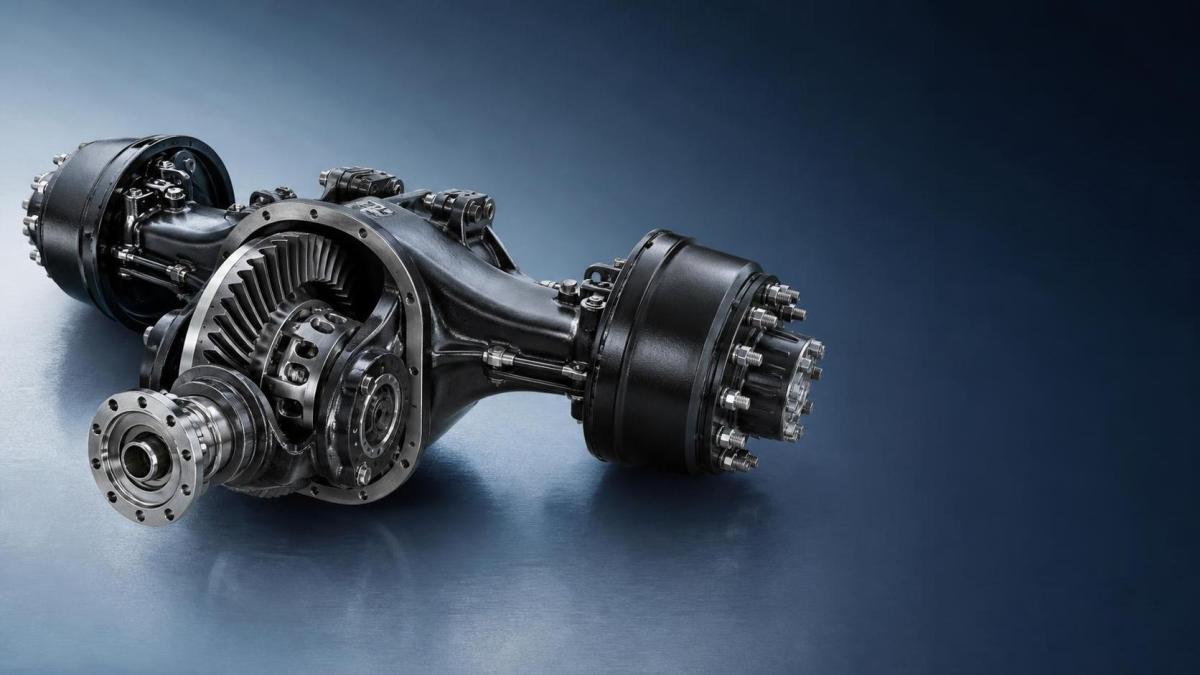
Torque enters the drive axle through the input flange, normally from the propeller shaft connected to the transmission output or an inter-axle differential in a tandem-drive arrangement. Inside the axle carrier, the input pinion transfers rotational force to the ring gear. The ring gear is bolted to the differential case, so its rotation drives the differential assembly and, through the side gears, the left and right axle shafts.
The torque path can be summarized as:
Transmission output → propeller shaft → input flange → pinion gear → ring gear → differential case → side gears → axle shafts → wheel hubs → tires.
Each stage changes the mechanical conditions. The propeller shaft generally operates at relatively high speed and lower torque. At the final drive, the pinion and ring gear reduction lowers rotational speed but multiplies torque. This is why the drive axle is exposed to very high tooth loads even when the engine itself is not producing its peak torque.
For a simplified assessment, wheel-end torque is influenced by engine torque, transmission ratio, final-drive ratio, driveline efficiency, and tire rolling radius. A low final-drive ratio numerically—such as 3.08:1—reduces engine speed at cruise compared with a 4.44:1 ratio, but it also provides less torque multiplication at the axle. A vehicle expected to start repeatedly on grades with dense payloads may require a different axle ratio from a long-haul tractor operating mainly on level highways.
Ratio selection therefore cannot be isolated from transmission gearing, tire diameter, engine torque curve, intended gross combination weight, startability requirement, road topography, and target cruise speed. A technically correct axle can still be poorly matched to the truck if its ratio is selected only for highway fuel economy.
The pinion-ring gear mesh is where axle durability is decided
The hypoid gear set in a conventional truck drive axle deserves particular attention. Unlike simple bevel gears, hypoid gears operate with an offset between the pinion and ring gear centerlines. This layout permits a lower driveline position and supports packaging requirements in heavy-duty vehicles, but it also introduces significant sliding action between tooth surfaces.
That sliding action requires the lubricant to maintain a durable protective film under high contact pressure. Inadequate oil specification, low oil level, excessive oil temperature, water ingress, or contamination by wear particles can rapidly damage the tooth surface. Typical progression begins with polishing or abnormal contact marks, followed by scoring, pitting, spalling, blue discoloration from overheating, or tooth-edge distress caused by incorrect contact pattern.
Gear noise is not merely a comfort issue. A whine on coast, drive, or both can indicate different faults:
- Noise under acceleration: often associated with drive-side gear contact, pinion-bearing preload, pinion depth, or excessive backlash.
- Noise during deceleration: may point to coast-side contact problems or gear setup errors.
- Noise that changes while cornering: can involve differential gears, wheel bearings, or axle shaft-related loading.
- Steady rumble independent of throttle: often requires inspection of carrier bearings, wheel-end bearings, tire condition, and driveline components rather than immediate replacement of the gear set.
When rebuilding an axle carrier, replacing gears without controlling pinion depth, bearing preload, ring-gear runout, backlash, and contact pattern is a common but expensive error. A gear set may rotate smoothly on the bench yet fail early under loaded road operation if its pattern is too close to the heel, toe, face, or flank of the tooth. Setup values must follow the axle manufacturer’s specific documentation; broad “typical” measurements are not a substitute for a model-specific procedure.
What the differential actually does—and what it does not do
The differential allows the left and right drive wheels to rotate at different speeds. This is essential during cornering because the outside wheel travels farther than the inside wheel. Without differential action, tires scrub severely, steering loads rise, and driveline wind-up can occur.
In an open differential, torque delivery is limited by the wheel with the lowest available traction. This is frequently misunderstood. The differential does not actively “send power” to the wheel that is slipping; it permits speed difference, while available tractive effort is constrained by the low-grip side. On wet pavement, loose soil, snow, or uneven construction roads, this can leave one wheel spinning while the other receives insufficient usable torque to move the vehicle.
For that reason, many heavy trucks use an inter-wheel differential lock, particularly in vocational, regional, and mixed-road fleets. When engaged, the lock mechanically couples the side gears or axle shafts so both wheels rotate together. This improves traction but should be used only when conditions require it and according to the vehicle manufacturer’s operating instructions. Engaging a differential lock on high-grip pavement or retaining it through tight turns can overload shafts, splines, gears, and tires.
Tandem-drive tractors add another layer: the power divider or inter-axle differential. It manages speed differences between the forward and rear drive axles. A vehicle may have an inter-axle lock, inter-wheel locks, or both. During technical inspection, these systems should not be treated as interchangeable. A fault in an inter-axle differential, lock actuator, air circuit, switch, or indicator can produce traction complaints that appear at first to be a rear differential problem.
Axle housing and suspension interfaces are part of the load path
It is tempting to assess the carrier and gears as the complete drive axle, but the housing and its suspension connections are equally important. The housing transmits vertical load, braking reaction, traction force, and road-impact loads to the suspension. A bent housing can alter axle shaft alignment and wheel-end geometry; loose or worn suspension interfaces can create driveline angle changes, uneven tire wear, and cyclic loading that shortens component life.
On multi-axle suspension systems, balance-shaft seats, trunnion supports, torque rods, spring seats, and U-bolt connections should be inspected alongside the drive axle. Wear at these points can shift load distribution between axles, increasing stress at wheel bearings and differential components even when the carrier itself is correctly assembled.
For vehicles based on Mercedes-Benz SK or Beiben NG80 configurations, suspension replacement work should verify casting geometry, bore dimensions, machining quality, mounting interfaces, and material consistency rather than relying on visual similarity. A component such as the Suspension Saddle Trunnion Seat / Balance Shaft Seat 6243250112 for Mercedes-Benz SK & Beiben NG80 affects the suspension load path adjacent to the axle and should be evaluated for dimensional compatibility with the actual vehicle arrangement.
Lubrication is a condition-monitoring issue, not a routine refill task
Axle lubricant performs several functions simultaneously: it separates gear tooth surfaces, cools the pinion and ring gear, protects bearings, carries contaminants toward the magnetic drain plug, and helps prevent corrosion. In a heavily loaded drive axle on a semi truck, lubricant quality is a direct indicator of internal condition.
Oil checks should consider more than level. A technically useful inspection includes:
- oil appearance and odor;
- presence of metallic debris on the magnetic plug;
- visible water contamination or emulsification;
- seal leakage at the pinion, carrier flange, hub, and axle shaft locations;
- evidence of overheating near the carrier and wheel ends;
- correct lubricant type for the axle’s hypoid gears and operating environment.
A small amount of fine metallic paste on a magnetic plug may be normal over a service interval, especially after break-in or recent repair. Large fragments, sharp particles, bronze-colored material, or rapidly increasing debris are not normal findings. They warrant investigation before the axle develops a catastrophic gear or bearing failure.
Oil level should be checked on level ground and according to the axle maker’s procedure. Overfilling can aerate lubricant or force oil past seals; underfilling compromises gear and bearing cooling. Lubricant change intervals should reflect the truck manufacturer’s instructions and actual duty severity. Long highway operation, high ambient temperature, off-road contamination, frequent water exposure, and sustained high-load operation do not impose the same maintenance demand.
Service points that reveal problems early
Preventive service is most effective when the inspection sequence follows how forces travel through the axle. Start externally, then move inward.
Input and carrier area. Check the pinion flange for looseness, seal leakage, damaged yokes, and abnormal radial movement. A pinion seal leak is sometimes treated as a minor gasket issue, but repeated leakage can indicate excessive pinion-bearing play, worn sealing surface, or incorrect assembly preload.
Housing condition. Inspect weld areas, spring-seat zones, torque-rod brackets, and areas near the differential carrier opening for cracks, deformation, corrosion, and oil seepage. Housing damage is particularly relevant after severe pothole strikes, curb impacts, or overloading events.
Wheel ends. Look for hub oil leakage, grease contamination where applicable, abnormal hub temperature, end-play issues, damaged studs, and seal condition. A failed wheel bearing can contaminate the axle lubrication system or generate heat that is wrongly attributed to the differential.
Axle shafts and splines. During shaft removal, inspect spline fretting, twist marks, surface cracks, and wear at contact points. Repeated shaft failures often indicate a system issue: incorrect torque rating, lock misuse, suspension misalignment, overload, abrupt traction events, or incompatible parts—not simply a defective shaft.
Breather function. A blocked axle breather raises internal pressure as oil heats. This can push lubricant past otherwise serviceable seals. Breathers are inexpensive but frequently neglected during maintenance.
Compatibility checks for replacement parts
Replacement decisions require more than matching a truck brand or axle family name. Different production series may use variations in spline count, shaft length, hub pilot dimensions, flange pattern, differential lock design, gear ratio, brake arrangement, and sensor provisions. For imported heavy trucks, the same badge may also appear with different axle specifications depending on market, chassis configuration, or original application.
Before approving a carrier, gear set, axle shaft, seal, housing-related component, or suspension mounting part, compare the following against the removed unit and the vehicle documentation:
- axle model identification and axle serial information where available;
- ring-gear tooth count and pinion tooth count;
- carrier mounting pattern and overall dimensional envelope;
- input flange dimensions and driveline connection type;
- differential lock configuration and actuator interface;
- axle shaft spline count, major diameter, effective length, and flange arrangement;
- hub, bearing, seal, and ABS sensor compatibility;
- housing and suspension mounting geometry.
Parts identification by photograph alone is a high-risk practice, particularly for axle and suspension components. Casting numbers can be useful, but they should be paired with measured dimensions and vehicle-specific data. A close-looking part may install physically while producing incorrect preload, misalignment, inadequate load support, or interference during suspension travel.
Interpreting failure patterns in service
Drive axle failures often provide evidence of the operating environment. Repeated ring-and-pinion failures can indicate poor setup, lubricant breakdown, excessive payload, or a ratio mismatch that keeps the driveline in high-torque conditions. Repeated hub seal failures may reflect blocked breathers, worn bearing adjustment, damaged spindle surfaces, or hub overheating. Broken axle shafts after traction events may be associated with differential-lock operation on firm ground or shock loading from wheel hop.
Technical evaluation should therefore distinguish between a failed component and a failed system. Replacing only the visibly damaged part can restore operation temporarily, but it does not eliminate the root cause if alignment, lubrication, operating practice, or adjacent suspension wear remains unaddressed.
The most reliable assessment of a drive axle on a semi truck combines specification review, road-symptom analysis, lubricant inspection, dimensional verification, and examination of surrounding suspension and driveline components. This approach is slower than replacing parts based on noise or visual damage alone, but it is the method most likely to protect axle life, maintain traction performance, and prevent repeated repair costs in demanding commercial service.